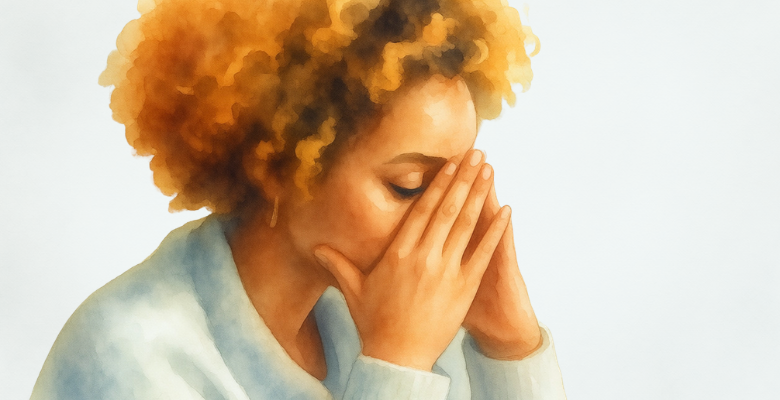
If over the past few months you've felt a restlessness that's hard to explain, thoughts that won't stop at night or a sense of being on alert for no clear reason, the numbers back up what you're going through: it's not exaggeration or "just nerves", it's one of the most common symptoms of perimenopause, and one of the least discussed.
A real peak, not a perception
The evidence describes a clear pattern: the risk of anxiety rises precisely during the menopause transition. The longitudinal SWAN study found that, compared with the premenopausal stage, women in perimenopause are at greater risk of anxiety symptoms, and Global Burden of Disease data show that the burden of anxiety disorders in perimenopausal women has grown over recent decades and is projected to keep rising until 2035. All of this coincides with the irregular fluctuation of oestrogen, which influences key neurotransmitters such as serotonin and GABA.
The numbers
A recent meta-analysis of more than a million participants puts the prevalence of anxiety symptoms at around 29% in perimenopause and 39% in postmenopause. The SWAN study also found that up to 51% of women aged 40 to 55 reported tension, nervousness or irritability, and one in four described frequent irritability or nervousness.
Why this peak happens
During perimenopause, the brain partly loses the neuroprotective effect that oestrogen used to provide. Add hot flashes, fragmented sleep and the stress that comes with this stage of life, and you get especially fertile ground for anxiety. Women already have, at baseline, almost twice the lifetime risk of men of developing an anxiety disorder; perimenopause adds an extra hormonal layer to that risk.
Why this matters
- Recognising the hormonal origin helps you stop seeing anxiety as a personal failure or a lack of control.
- It means you can seek the right support in time, instead of downplaying the symptom for years.
- It makes for better-informed conversations with your doctor or mental health professional.
- It opens the door to nervous-system regulation strategies, which are useful whatever the exact cause.
A note
If your anxiety is intense, persistent or interferes with your daily life, please talk to your doctor or a mental health professional. This information is educational and does not replace an individual clinical assessment.
- Bromberger JT, Kravitz HM, Chang Y, et al. (2013). Does risk for anxiety increase during the menopausal transition? Study of Women's Health Across the Nation (SWAN). Menopause, 20(5), 488-495.
- Balasubramanian I, Abhijita B, Krishnamoorthy Y, et al. (2026). Prevalence and incidence of depressive, anxiety, and insomnia symptoms in perimenopausal and postmenopausal women: Systematic review and meta-analysis. General Hospital Psychiatry.
- Zhang Y, Hu TT, Cheng YR, et al. (2025). Global, regional, and national burden of anxiety disorders during the perimenopause (1990-2021) and projections to 2035. BMC Women's Health, 25(1), 11.
- McLean CP, Asnaani A, Litz BT, Hofmann SG (2011). Gender differences in anxiety disorders: prevalence, course of illness, comorbidity and burden of illness. Journal of Psychiatric Research, 45(8), 1027-1035.