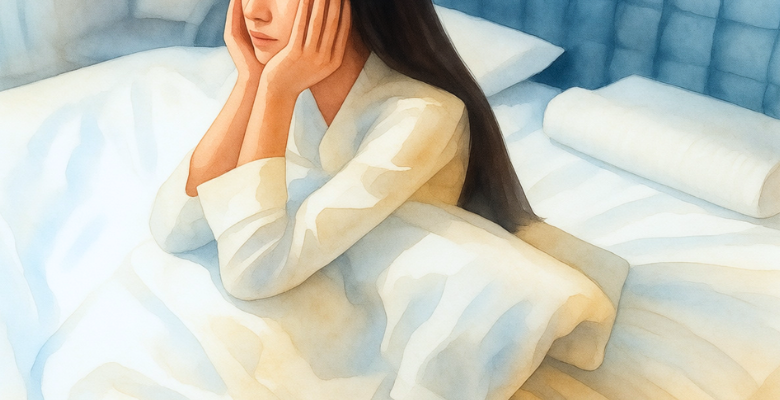
You struggle to fall asleep, you wake up several times, or you simply don't feel as rested as before, even though you sleep the same number of hours. Women's sleep changes in menopause for more than one reason, and understanding them is the first step to tackling it.
More than night sweats
It's true that night-time hot flashes fragment sleep, but they're not the only cause: the drop in oestrogen and progesterone directly affects the mechanisms that regulate the sleep-wake cycle, whether or not there is sweating. This explains why some women without intense hot flashes still notice that their sleep is far less restorative.
What the evidence says
- Between 16% and 60% of peri- and postmenopausal women report sleep problems or insomnia symptoms, according to recent reviews drawing on large cohorts such as the SWAN study (United States).
- REM sleep and deep sleep are essential for memory consolidation, cell regeneration and emotional regulation, functions that are compromised when sleep is fragmented over time.
- A lack of restorative sleep is also linked to a higher risk of anxiety, irritability and difficulty regulating weight.
The cycle worth understanding
Hot flashes, anxiety and insomnia feed each other: hot flashes interrupt sleep, lack of sleep increases anxiety and sensitivity to hot flashes, and so on. That's why addressing sleep early can have a positive knock-on effect on other symptoms.
Before thinking about treatments
- Consistent sleep times, even at weekends.
- A cool, dark and quiet bedroom.
- Avoid caffeine, alcohol and screens for several hours before bed.
- Regular exercise, avoiding intense activity close to bedtime.
A note
This content is for informational purposes only and does not replace a medical consultation.
- Lumsden MA, Dekkers OM, Faubion SS, et al. (2025). European Society of Endocrinology clinical practice guideline for evaluation and management of menopause and the perimenopause. European Journal of Endocrinology, 193(4), G49-G81.
- Troìa L, Garassino M, Volpicelli AI, et al. (2025). Sleep Disturbance and Perimenopause: A Narrative Review. Journal of Clinical Medicine, 14(5), 1479.
- Balasubramanian I, Abhijita B, Krishnamoorthy Y, et al. (2026). Prevalence and incidence of depressive, anxiety, and insomnia symptoms in perimenopausal and postmenopausal women: Systematic review and meta-analysis. General Hospital Psychiatry.