Before you think about a supplement, it's worth looking at your plate. Food is still the foundation for meeting your Omega-3 needs, and understanding how much foods actually provide helps you know whether extra support is really needed.
Marine sources: the most efficient
Oily fish is by far the most direct source of EPA and DHA, because it doesn't require any conversion process in the body.
- Mackerel: approximately 4.6 g of EPA+DHA per 100 g — the most concentrated fish.
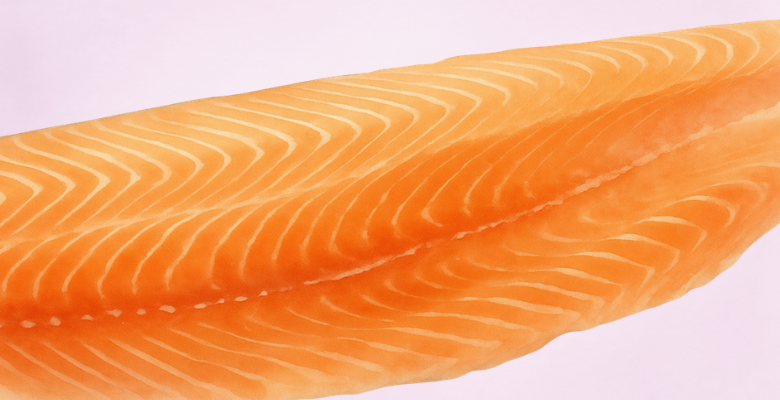
- Wild salmon: between 2 and 2.6 g of EPA+DHA per 100 g.
- Sardines (fresh or canned): between 1 and 2.5 g of EPA+DHA per 100 g.
- Herring and anchovies: between 1 and 2.5 g of EPA+DHA per 100 g.
- Trout: between 0.8 and 1.5 g of EPA+DHA per 100 g.
How much you actually need to eat
With 2-3 servings of oily fish per week (about 100-150 g per serving), you cover, on average, the daily recommendation of 250-500 mg of EPA+DHA. A single serving of salmon can cover 7 to 15 times that minimum daily dose. Canned sardines are one of the most accessible options: a standard tin provides around 1,500 mg of EPA+DHA.
Plant sources: useful, but with a real limitation
Chia and flax seeds, along with walnuts, are rich in ALA (alpha-linolenic acid), the plant-based form of Omega-3. The problem is that the human body converts this ALA into EPA and DHA to a very limited extent: only about 5-10% converts to EPA, and less than 1% to DHA. This conversion tends to be somewhat more efficient in women than in men, but it remains low either way.
- Chia seeds: 10 g provide approximately 1.7 g of ALA (better if consumed ground).
- Ground flaxseed: 15 g provide approximately 3.4 g of ALA.
- Walnuts: a 20-30 g handful a day is a practical amount and has been consistently associated with better memory and attention.
These amounts cover, in practice, the average recommended ALA intake (around 1.1-1.6 g/day, depending on each person's calorie intake), but they don't replace the direct EPA and DHA provided by oily fish or algae.
For those who don't eat fish: algae oil
Microalgae oil (Schizochytrium sp.) is the only plant-based source that provides EPA and DHA already formed, without relying on the limited conversion of ALA. It's the recommended option for those following a vegan or vegetarian diet who want to ensure adequate levels of these fatty acids, particularly for brain health.
A practical combination for everyday life
- 2-3 servings of oily fish per week, prioritising smaller varieties (sardine, mackerel, anchovy) which concentrate fewer heavy metals.
- Daily, 1-2 tablespoons of chia seeds or ground flaxseed, or a handful of walnuts.
- If fish intake is low or non-existent, consider a verified quality Omega-3 supplement as support, not as a substitute for food.
If you'd like to understand better why this nutrient becomes especially relevant from age 45 onwards, you can also read our article on Omega-3 and menopause.
This information is educational and does not replace individualised nutritional advice. If you have questions about your diet or whether you need supplementation, consult your doctor or a registered dietitian.
- European Commission (2012). Regulation (EU) No 432/2012 — Authorised health claims: EPA and DHA contribute to the normal function of the heart (250 mg/day).
- EFSA NDA Panel (2010). Scientific Opinion on Dietary Reference Values for fats, including saturated fatty acids, polyunsaturated fatty acids, monounsaturated fatty acids, trans fatty acids, and cholesterol. EFSA Journal, 8(3), 1461.
- Baker EJ, Miles EA, Burdge GC, Yaqoob P, Calder PC (2016). Metabolism and functional effects of plant-derived omega-3 fatty acids in humans. Progress in Lipid Research, 64, 30-56.
- EFSA NDA Panel (2021). Safety of oil from Schizochytrium limacinum (strain FCC-3204) for use in food supplements as a novel food pursuant to Regulation (EU) 2015/2283. EFSA Journal, 19(1), e06345.