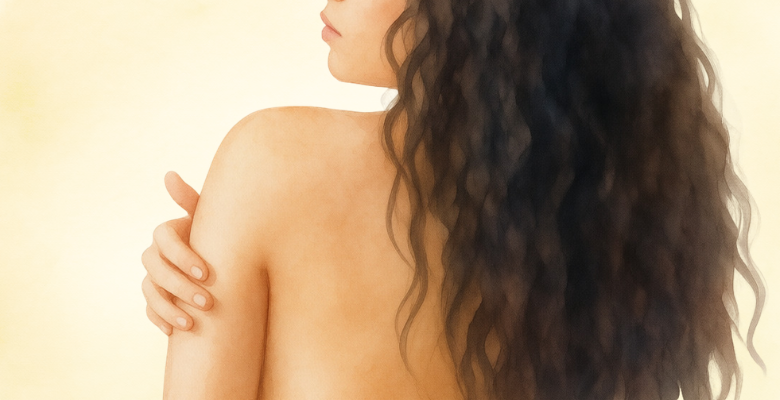
"My skin is drier than ever." "My hair doesn't have the same strength." "It feels like I've aged overnight in just a few years." These are some of the most common concerns during perimenopause and menopause.
Although we tend to associate this stage with hot flushes or sleep disturbances, many women also start to notice visible changes in their skin and hair. And it is no coincidence.
What happens to the skin during menopause?
Estrogens play an important role in skin health: they act on keratinocytes, fibroblasts and hair follicles, and are associated with maintaining collagen, hydration, elasticity and wound healing. There is a strong correlation between skin collagen loss and the estrogen deficiency of menopause (Calleja-Agius and Brincat, 2012).
When hormone levels fall, the skin can become thinner, drier, more sensitive and less elastic, and more prone to wrinkles and pigmentation changes (Thornton, 2013).
Why does hair fall out more?
Hair also responds to hormonal changes. Estrogens can alter the growth cycle of the follicle, and during menopause it is common to see reduced thickness, slower growth, greater fragility, loss of density and increased shedding (Grymowicz et al., 2020).
It is worth knowing that hair loss has many possible causes besides hormonal ones. If it is intense or sudden, it deserves a consultation with your doctor or dermatologist to rule out other factors. And although hormone therapy is something to weigh up with your gynaecologist for other reasons, it is currently not indicated solely to treat hair loss (Lee et al., 2026).
menoelle®: a specific approach to menopause
menoelle® has developed a range of products designed specifically to support women through perimenopause and menopause. One of its main ingredients is EstroG-100®, a patented combination of plant extracts developed to support women during this stage without using hormones or phytoestrogens.
In addition, the vitamin and mineral complex in menoelle® (classic) includes nutrients with health claims authorised in the European Union related to skin and hair: biotin contributes to the maintenance of normal hair and skin, zinc contributes to the maintenance of normal hair, nails and skin, and vitamin C contributes to normal collagen formation for the normal function of skin. These are claims about nutrients, not promises about the product: we have not found studies measuring an effect of menoelle® on skin or hair.
The key point
Menopause doesn't only affect hormones. It can also influence skin quality, hydration, collagen production, hair growth and the perception of overall wellbeing.
Because caring for your skin and hair is not a matter of vanity. It is also a way of caring for a woman's wellbeing, confidence and overall health.
Transparency: menoelle is a brand we collaborate with. We mention it here because we find it a relevant proposal for our community, not in exchange for presenting it as a neutral recommendation. This content is for information only and does not replace the advice of a healthcare professional.
- Calleja-Agius J, Brincat M (2012). The effect of menopause on the skin and other connective tissues. Gynecological Endocrinology, 28(4), 273-277.
- Thornton MJ (2013). Estrogens and aging skin. Dermato-Endocrinology, 5(2), 264-270.
- Grymowicz M, Rudnicka E, Podfigurna A, et al. (2020). Hormonal Effects on Hair Follicles. International Journal of Molecular Sciences, 21(15), 5342.
- Lee J, Krishnegowda R, Miteva MI (2026). Hormone Replacement Therapy and Hair: A Review for Trichologists Treating Menopausal Women. Dermatology, 242(3), 264-267.
- European Commission (2012). Commission Regulation (EU) No 432/2012 establishing a list of permitted health claims made on foods (biotin, zinc and vitamin C).
- PhytoLife Pharma GmbH. menoelle® tablets: product information (ingredients and claims declared by the manufacturer).