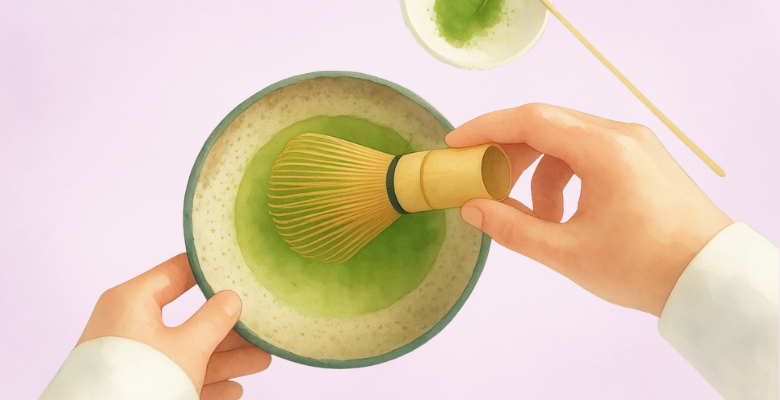
Until now, when we've talked about green tea in this space, we've almost always meant the classic infusion or its concentrated extract in capsules. But there's a third form, with its own identity, its own history and its own science: matcha. It's worth understanding what makes it so different, because it isn't simply "powdered green tea".
The difference starts with cultivation
Before harvest, the plants destined to become matcha are covered for several weeks to reduce their direct sun exposure. This prolonged shade changes the leaf's physiology: it intensifies chlorophyll production (hence its especially intense green colour) and encourages the development of amino acids, particularly L-theanine, a compound that isn't present in the same way in a green tea grown in full sun.
The difference continues in how it's consumed
With traditional green tea, the leaves are steeped in hot water and then removed: what you drink is whatever the water managed to extract from the leaf. With matcha, the process is entirely different: the young leaves are ground into a very fine powder, and that powder is dissolved whole into water or plant-based milk. In other words, you're not extracting compounds from the leaf — you're consuming the whole leaf.
This difference has a direct consequence: because you're taking in the whole leaf, matcha provides a considerably higher concentration of catechins, including EGCG, compared with a cup of steeped green tea, where much of those compounds stay behind in the discarded leaf.
Why does this matter to you?
Because it isn't just a botanical curiosity: the way matcha is grown and consumed explains why its profile is so distinctive — natural caffeine combined with an unusually high concentration of L-theanine, the same combination behind the "calm energy" feeling many people describe when drinking it, which we'll explore further in the next post in this series.
It also explains why matcha has a place of its own within the green tea family: it doesn't compete with the classic infusion or the concentrated extract in capsules — it complements them, each with a different purpose depending on what you're looking for at any given moment of the day.
Transparency: We collaborate with TigoGreen. This content is for informational purposes and does not constitute medical advice.
- Chen X, Ye K, Xu Y, Zhao Y, Zhao D (2022). Effect of Shading on the Morphological, Physiological, and Biochemical Characteristics as Well as the Transcriptome of Matcha Green Tea. International Journal of Molecular Sciences, 23(21), 13401.
- Weiss DJ, Anderton CR (2003). Determination of catechins in matcha green tea by micellar electrokinetic chromatography. Journal of Chromatography A, 1011(1-2), 173-180.
- Owen GN, Parnell H, De Bruin EA, Rycroft JA (2008). The combined effects of L-theanine and caffeine on cognitive performance and mood. Nutritional Neuroscience, 11(4), 193-198.